
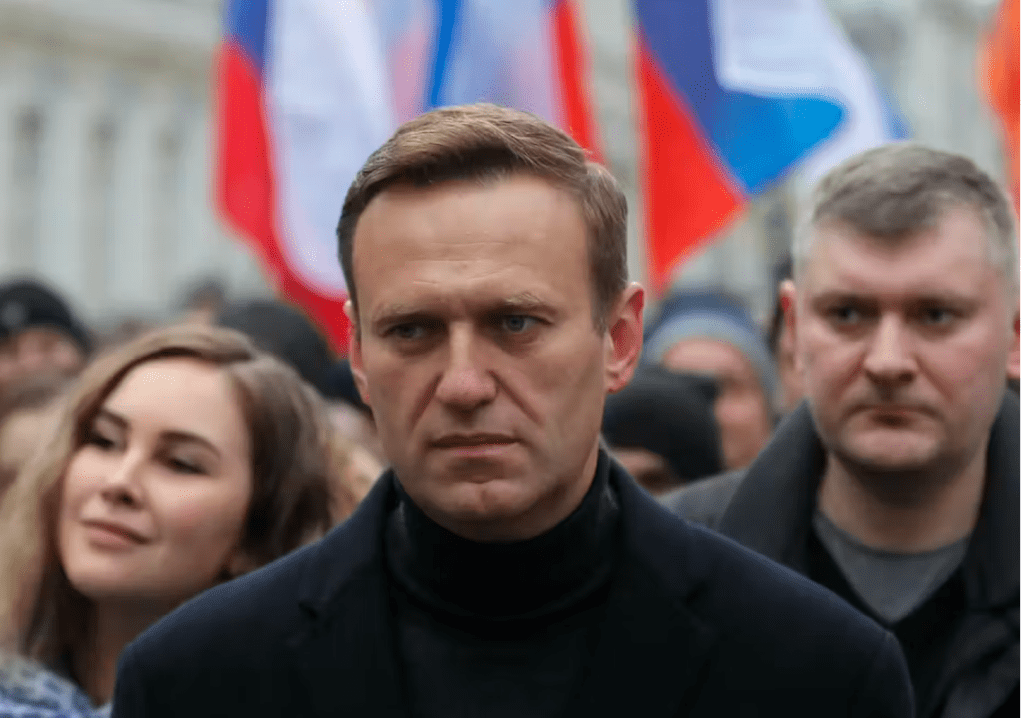
The news of Alexei Navalnîi’s death made global headlines, prompting reflection on the significance of his case not only for Russian society but also for the international community. Navalnîi was more than just a political figure; he symbolised resistance, hope, and the pursuit of democracy in an era dominated by Putin’s authoritarian rule. His tragic demise felt like a scene from a movie, where the hero is slain by the villain, only this time, it was a grim reality—a profound tragedy not only against a human but also against ideals Navalnîi stood for.
Alexei Navalnîi stood up for democracy, anti-corruption and freedom.
He was a prominent Russian opposition leader, anti-corruption activist, and politician known for his fearless investigations into the corruption plaguing Russia’s political elite. His relentless activism and outspoken criticism of the Kremlin made him a thorn in the side of the Russian government, leading to numerous arrests, legal troubles, and attempts to silence him through various means.
It is no surprise “the regime wanted him dead” (former senior Kremlin official told The Moscow Times, 2024) like every other political leader opposing current regime, nothing else but a brutal game of chess, where the rules are constantly manipulated by those in power to maintain control and suppress dissent.
We may ask ourselves where are the Russian people? Don’t they have a sense of justice? Aren’t they aspiring to live in a democratic state? Well, Colesnikov (2023) provided rather a simple but relevant answer;
“Most Russians remained—as ever—interested only in being left alone to get on with their lives”.
Colesnikov (2023)
Witnessing the response of the Russian population, the absence of the anticipated large-scale protests leads us to surmise that their behaviour is likely influenced by fear, government repression, and media control. It’s not a matter of their lack of understanding regarding the situation; but rather prefer to stay silence for their own sake, let the dust to settle and the regime will eventually change for better or for worse. It is nearly two years from Russian invasion of Ukraine and perhaps it is upsetting but also understandable people’s reaction in times of danger, staying alive rather than fighting against the storm.
Even after Navalnîi’s death, it is unlikely we will see protests in the upcoming days not only because of fear but also heavy regulations. And if there are a few lessons we have learnt from his fate is that Russia is in a democratic crisis where potential opposition is targeted, suppressed in barbaric ways and the principles of democracy, political competition has no place in Russian political arena.
Moreover, not that it is new lesson but rather a revision where violence still used as prime tool to keep people under control, maintain and expand political power. Perhaps, it is another lesson of remarkably successful tyrant in power and speaking up against the regime is most likely get you killed. Not to mention that the death of Navalnîi comes in handy for the upcoming presidential election.
The presidential election in Russia will be held on 15–17 March 2024
Are there any other methods to preserve the remains of democracy ? Fighting fire with fire? Stay silent? Or advocating for justice, accountability through peaceful means? The truth is that there is no one answer as the issue is quite complex and requires a multifaceted approach to drive positive changes in society. People are at the heart of these changes and they may forget the extent of their collective power when united, the repression, fear, manipulation and division is to blame.
Perhaps he believed in the collective power and the support of Russian people to drive change. Many would say including myself that his decision to return to Russia was quite naive or overly optimistic, given the authoritarian nature of the Russian government and the likelihood of retaliation against him. However, this does no mean that the attempts on his life would have stoped.
Navalnîi’s return to Russia and subsequent arrest have garnered international attention, shining a spotlight on his case and the broader issues of human rights and democracy. His courageous stance will likely be remembered in history as that of a defender of democracy, representing a noble effort toward realising what Russia ought to be.
 Veronica Maimescu
Leave a comment