
Defining human rights and understanding how they evolved is essential in determining how successful these have been in legitimising the United Nations (U.N). It is a complex concept which has been widely discussed and analysed by many scholars and organisations. The critics involve not only the positive aspects but also contradictory views concerning its development and the role it had in the past and now. Drilling deeper to answer the question, some definitions that best project the basic sense of human rights actuality attributes to human characteristic.
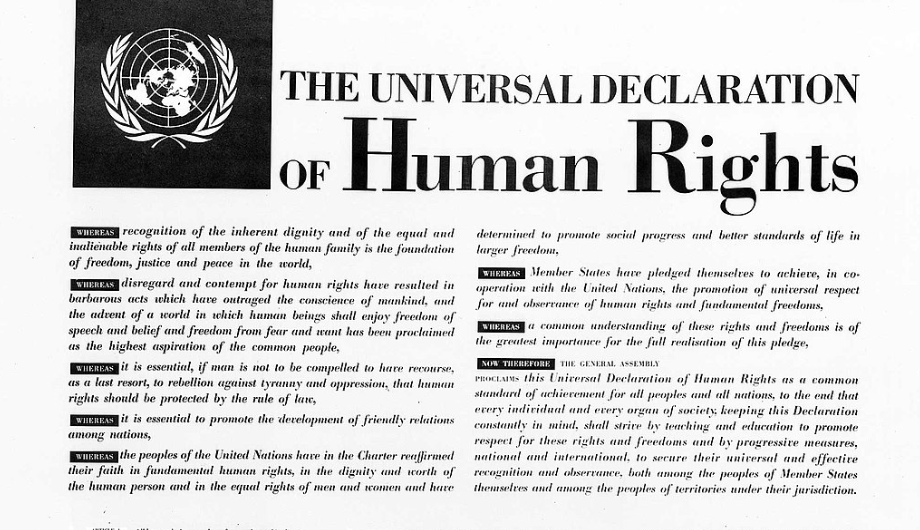
Donnelly (2013) assumes that “The rights that one has because one is human.” People from everywhere have these basic inherited rights. Similarly, in Article 1 from the Universal Declaration of Human Rights (U.D.H.R), the concept is defined as “All human beings are born free and equal in dignity and rights” (U.D.H.R, 1958). The document attests human rights universality, and it is at the basis of foundation of justice, freedom, and peace, which are the legitimising principles of the U.N. Many argue that human rights have gained universality and become the lingua franca of global moral thought (Lopez, 2018, p. 16). It became so omnipresent that it seems to require an equally extensive history. And again, Hunt (2008) assumes that human rights demand three interlocking qualities “to be natural, equal, and universal, acceptable everywhere”. Moyn (2017) adopts a more radical view on what human rights mean, he argues that human rights are relatively a moral concept, not practical.
The evolution of human rights has a complex trajectory; therefore, from a social legitimisation, it transcends into universal legally binding treaties, which can be considered a considerable success for U.N. and a step forward for human rights. Despite this, compliance by the entire global community is a significant challenge that is may be impossible to achieve because of multiple and continuous violations and other issues, which somehow raises the question of effectiveness and what role human rights have in society nowadays.
The essay’s main objective is to determine how successful human rights have been in legitimising the United Nations? The analysis is mainly centred on the rational-legal legitimisation of the U.N, and realist theories in relation to it. The conceptual and methodological framework to measure the progress of human rights in legitimising the UN is the analysis of indicators based on the principles of universality, impartiality, and objectivity. A criterion often used by the U.N to assess effectiveness is the cooperation between member states in meeting their obligations and strengthening their capacity to meet the objective set (U.D.H.R, 2022). Also, the analysis is based on three critical success criteria, the impact, relevance, and sustainability of human rights in legitimising the U.N.
In the aftermath of WWII, on the 24th of October 1945, the United Nations (U. N.) were born because of the need to restore global peace and security. It triggered the need for states to increase multilateral cooperation to avoid such disastrous events in the future (Weiss, 2015).
Human rights violations are among the root cause of conflicts and threats to peace and security. These were and continue to be the two main factors that brought states together and agreed upon establishing a balance between great world powers and ensuring preventive measures and norms are established to eliminate the threats. According to (Amnesty International, 2017), “The concept of human rights arose stronger after World War II. The extermination by Nazi Germany of over six million Jews, Sinti and Romani (gypsies), homosexuals, and persons with disabilities horrified the world“.
In contrast, Moyn argues that human rights appeared in the moral consciousness only in the 1970s. The arguments direct towards the higher possibility for them to become a more prominent movement in society which the author motivates that it has not (Moyn, 2017, p. 171). Despite controversial views, the evidence shows that the atrocities and war crimes committed boosted the need for human rights recognition on an international level and the need for a collective legitimisation, that could be made possible through an International Organisation aiming to express a more general will of the people. The “people will” generally refer to democratic regimes which are characterized by popular control, fundamental rights, participatory engagement, and other aspects.
Even if democracy was not mentioned in the UN Charter, it reflects the fundamental principle that “the will of the people is the source of legitimacy of sovereign states and, therefore, of the United Nations as a whole “(United Nations, 2022). Moyn (2017) argued that” human rights become one of birth after death, especially after Jewish death.” It can be observed that the scholar believes that human rights is a utopian concept, on the other hand it is much needed in society and were born to prevent mass atrocities such as genocide and many other drastic violations. Nevertheless, it is argued that human rights must gain scientific weight (Moyn, 2017) to have more power in the world and straighten the UN’s position in the global arena which may prove to be a valid and a real opportunity for human rights future.
Human rights have been among important pillars in laying the foundation of the United Nations, even if a much higher impact was expected. The role of human rights in society is gaining different shapes, and it is manifesting in various ways. For example, the fight for women’s rights intensified despite existing issues in terms of determining a consensus on these. The first treaties ratified by the U.N. to protect women’s rights were connected to trafficking and prostitution, the nationality of married women, consent to marriage, women’s political rights, the minimum age for marriage, and registration of marriages (Marks, 2017).
In addition to that, the gradual progress of women’s rights in the Declaration on the Elimination of Discrimination against Women, followed by the Convention on the Elimination of All Forms of Discrimination against women, was a huge step forward in status equality (Pinto, 2021). There is a visible improvement however, women in various parts of the world still do not have the same rights as men. Many activists and non-governmental organisations promote and protect human rights, and the number continues to grow which a good development. Along with it, the ideology in human minds is growing significantly, therefore contributing to an increasing level of success in legitimising the United Nations.
Human rights revolution has aided in building many institutions that help advocate and protect them. On the other hand, some aspects inflict doubt on whether these have a meaningful impact upon legitimising U.N. or constitute a utopian concept that cannot have a tangible impact upon shifting the world into a more equal society. Samuel Moyn points out that human rights do not directly commit to material equality “a ceiling on the wealth gap between rich and poor is absent from U.D.H.R.” (Moyn, 2019, p. 213).The scholar suggests that human rights provide status equality.
However, it does not guarantee distributive equality(Moyn, 2019, p. 213). Nevertheless, due to the growing movement for human rights, the U.N. organs such as International Court of Justice (I.C.J.) and International Criminal Court (I.C.C.) could hold individuals accountable for gross violations. The institution supports the I.C.C and prosecutorial mechanisms to hold perpetrators accountable for their crimes. On the other side, the world faces uncertainties that could change the international order. Thus, impacting the evolution of human rights and the U.N legitimation by shifting the events towards an unfavourable direction as these are firmly connected and exercise influence on one another.
Human rights as one of the major pillars in legitimising the U.Nwas quite fragile in the past, mainly because of the lack of legally bounding power over states that violate human rights. Despite high social legitimisation and recognition of human rights universality, it is still an ideal that is difficult or even entirely impossible to enforce over states. It could have been because of multiple factors; some include cultural differences, religion, economic environment, and dictatorial regimes.
Indeed, all human rights have a significant role in society, more or less. It remains an important instrument to empower people and prevent conflicts and potential violations. On the other hand, violations of human rights increased, despite the efforts of the U.N. and other institutions to set standards that can help minimise the threats. Gutteres (2021) stated that “The world faces a pandemic of human rights abuses in the wake of Covid-19“. Violations of human rights can significantly contribute to the escalations of conflicts. There are multiple active conflicts worldwide; some examples are Ukraine, Yemen, Syria, and Iraq.
Initially, the main body responsible for human rights on global level was the Human Rights Commission whichcarried out most of the standard-setting activity of the early years following the adoption of the U.D.H.R. The U.D.H.R has established general principles that introduced human rights into international legislation. The declaration universality has tried to avoid controversial issues; it employed general or vague phrases to adapt to the variety of system values of states (Kaplan, 2018). Since then, the organisation has been eager to protect human rights via legal mechanisms and activities such as conflict prevention, peacekeeping missions, and other resolutions put in force by General Assembly.
The high level of abuses was the primary trigger in adopting the Universal Declaration that lays general standards for promoting and protecting human rights rather than enforcement. Human rights as an ideal can be interpreted differently, aspect that can boost the risk for it to be used for radical causes; it can be a dangerous instrument in the wrong hands. Nonetheless, it is still important to acknowledge that it brought small but meaningful successes such as greater freedom, independence, autonomy, and violations have been prevented (United Nations, 2015); these areessential contributors to the collective legalisation of United Nation.
As discussed previously, despite multiple efforts on the ground, the Declaration is not a legally binding mechanism.However, it includes a series of principles and rights based on general standards, which contributed to the adoption of legally binding international mechanisms, such as the International Covenant on Civil and Political Rights (ICCPR) (Marks, 2017).
It seems that Human Rights should be much more successful in legitimising the U.N. by now as it has gained global legal power. Human rights and U.N. are somewhat in a transactional relationship. The more successful these are in legitimising the institution, the more legit power it has to enable human rights protection. It is crucial to acknowledge that the U.N. legitimisation cannot stand alone on human rights as the central and only pillar that supports legitimisation. Instead, along with other significant contributors, the organisation still enjoys a strong legitimacy, despite the declining confidence in the U.N. and the risks of losing legitimacy as a guardian of peace and security (Toshiki, 2022). It is highly disputable if the Human Rights ideal alone could have built the legit foundation, but the impact on U.N. legitimisation is indispensable. Nevertheless, it implies a strong alignment with other elements (central pillars) that could have an equal or even higher impact on U.N legitimisation.
Another criterion to determine how successful human rights are in legitimising the U.N. is determining how relevant it is. As highlighted above, one of the significant contributors to its inception was the thrive for global peace and security, concepts that are strongly connected with Human Rights. For United Nation to do not repeat the fate of the League of Nations, it had to convince significant powers such as Russia, China, U.S.A, United Kingdom, and France to be member states, work together and follow the norms set in the Charter. The more extensive the list of members of U.N the higher is the widespread acceptance of the values and Charter.
The international society can exercise its global power and influence on governments through binding and non-binding instruments treaties. Some examples include customs, norms, general principles, and other sources of international law. States, in their turn, impact domestic law and culture. According to (Besson, 2015, p. 279), when human rights are approached as legal norms, these are primarily guaranteed by domestic law in the form of a constitutional bill of rights and on a global level by international law. From a rational and legal perspective, human rights are relevant in the legitimisation of the U.N.
First, because human rights are no longer only a moral abstract concept, these have gained rational-legal authority in the form of laws, rules, norms, and procedures that must be respected and obeyed. Based on Kulnazarova (2013) the International Bill of Human Rights (IBHR) incorporates the U.D.H.R, the International Covenant on Economic, Social, and Cultural Rights (ICESCR), the I.C.C.R and other optional protocols. Despite the lack of international instruments, these laws show success in punishing and holding states accountable. Among the commonly used tactics are sanctions. However, the efficiency raises questions and disputes. For example, Gutmann et al. (2018) argued that sometimes imposing sanctions could harm civilians and create humanitarian disasters and collateral damage.
The rights and freedoms from U.D.H.R. continue to construct the foundation for international human rights law. Lawyers and judges summon the principles and existing treaties when making decisions, and many constitutions are based on the Bill. The U.D.H.R. was and still is the ground-breaking document setting universal standards. Moyn (2017, p. 178) believes that politics of human rights must transcend judges. Thus, movements relying on judges alone are weak.
No less relevant is the International Court of Justice, the primary judicial organ of the U.N., which is understood as an body concerned with guarding and advancing human rights as community interests (Çalı, 2019). In this view, human rights offer a reference point to interrogate the normative structure of international law, focusing on whether some normative hierarchies or norms bind states without their explicit consent. Second, the I.C.J. may assume a humanising approach when assessing the concrete operation of international law, requiring that international law not only pay due regard to the rights of states but also recognise the rights of individuals, groups, and the human consequences of state conduct. The U.N. is where the lawful authority moderates’ power because law and legitimacy overlap, considering the identity of the community of nations. An international community exists if there is a shared understanding and approval of what forms legitimate conduct by the actors in world affairs.
Second, human rights constitute the legitimacy of democracies; thus, U.N. Guterres (2022) stated that the world must connect to act as one and commit to a future where the rule of law and human rights are paramount to democracy. Most democratic states stay determined to respect human rights norms, at least at the level of formal compliance with the provisions of national and international law (O’Cinneide, 2013). In general, including human rights into national legal systems and the ability to enforce them through laws attracts broad support. Nonetheless, the legitimacy challenges that human rights law confronts are far-reaching and risk becoming an existential threat.
Third, human rights within the U.N. context are set to shape the world by setting common standards and acknowledging the impossibility of eliminating completely the violations. Many scholars criticise many aspects of the United Nations, including lack of action and the inability to hold states and individuals accountable for human rights violations.
McGlinchey (2022) claimed that realists, although they do not reject the organisation altogether, the world is anarchic. States will yet resort to war despite the efforts to prevent this from happening, which prove to have little absolute authority. Generally, realists believe that U.N. appears to be successful when operating in the interests of powerful developed states such as the U.S. or the U.K. Nevertheless, if that condition is reversed and it becomes a block to national interests, the equation may change. An example is the failure of the Security Council to implement Resolutions to end Russia’s aggression in Ukraine because it has been vetoed by a few states, including Russia (UN SC, 2022).
Without a doubt, Human Rights have an important role in the continuous legitimisation of the United Nations. As legitimisation can be variable, the level of success can also change. Legitimacy drift arises when an institution loses legitimacy by failing to adjust itself to changing circumstances (Stephen, 2018). As discussed previously, Human Rights hasn’t been very successful because of multiple reasons, such as the usage of Human Rights as a pretext for political interests and lack of compliance with human rights norms. Also, issues in terms of cooperation between states challenge the universality of Human rights, and critics that emphasise that these express Western values, morals, and norms (Shaheed & Richter, 2018). Bellamy (2022) stated that ” foreign assistance for governance and human rights are far-fetched to deliver sustainable national improvements without genuine local political leadership.” The international institution is powerless to intervene if the national regimes do not align with its values.
Besides that, the judgment of the UN represents the dominant opinion of the foreign offices and other actors involved in the management and leadership of the governments of Member states and not necessarily the will of the people that may face injustice, exploitation, and hate. Hunt (2008) believes that to be meaningful human rights must gain political content. Can this mean a much higher power of human rights towards legitimising the international institutions? It is highly questionable because of controversial arguments provided by scholars. Samuel Moyn, for example, argues that Human Rights have been used as an instrument by states to justify aggression toward other states (Moyn, 2019).
An actual and rather disturbing example is the Russian invasion of Ukraine, where Russia claimed that the rights of Russian citizens had been violated by the Ukrainian government, therefore, justifying the invasion under the pretext of “denazification.” The one and the only organisation that aims to ensure global peace, security, and protection of human rights failed in many ways, the aspects that cannot be neglected. The Security Council is the leading organ responsible for peace and security, which has a legitimate deficiency because member states evaluated that it far outweighs positive implications (Binder & Heupel, 2015). It is vital to acknowledge the challenges and limitations of the organisation as an international legal instrument. Massive violations continue to occur during armed conflict, particularly when ignited by a resurgence of racism, xenophobia, and religious fanaticism.
Humanitarian needs have grown enormously, and human rights are under continued assault worldwide. With even a higher scepticism, Moyn claims that human rights do not intervene in power politics, and for this reason, they often seem to make little practical difference as they are not realistic enough; these must become more scientific (Moyn, 2017, p. 177).
Besides that, Henrard (2020) discusses that the European Court of Human Rights had provided opportunities for a nationalist address that can be considered in line with human rights but at the cross with the universality of human rights. The Court tolerated the statements of liberal democratic states to infringe the fundamental rights of Muslim minorities which could send a message of disproportionate distribution, or inequalities in interpretation of Human Rights standards therefore, creating multiple barriers and issues between states leading to conflicts.
To conclude, human rights have a growing impact on legitimising United Nations. The organisation was founded on the grounds of promoting and keeping peace and security along with protecting human rights. Many scholars argue that human rights strongly arose after the devastating events of World War II. Despite contentious views, the atrocities and war crimes committed roused the need for human rights recognition for a collective legitimisation. It became an opportunity for states to work together in achieving these goals. It became possible with the foundation of the U.N. Even if there are various disputes and even wars between nations.
The developments in promoting and protecting human rights took a huge step forward from a moral-political idea to legally binding treaties. Human Rights are no longer only a moral abstract concept, but these have gained rational-legal authority in the form of laws, rules, norms, and procedures which are binding such as the I.C.S.C.R and the I.C.C.P.R and Optional Protocols (Kulnazarova, 2013).
Also, human rights constitute the legitimacy of democracies, thus of U.N. Human Rights within the U.N. context set to shape the world by setting common standards, acknowledging the impossibility of fully eliminating violations. In terms of sustainability, it is questionable whether human rights have been successful because of various reasons; political interests, lack of compliance, issues in cooperation between states, challenges in terms of the universality of human rights, and critics that emphasise that these express Western values, morals, and norms (Shaheed & Richter, 2018).
Despite the U.N.’s limitations in preventing human rights violations globally, it has become the best legitimate instrument to promote and protect human rights. It was among the prominent events that led to the need for governments to foster international peace, establishing, therefore, the United Nations as a legit critical instrument to facilitate peace, security, and protect human rights. Nevertheless, there is a vast gap between common standards and human rights in the practical world; thus, Human rights alone may not be enough for a successful legitimisation of United Nations.
References
- Çalı, B. E. Z. &. M. L., 2019. The International Court of Justice as an Integrator, Developer and Globaliser of International Human Rights Law. . In: S. M, ed. Human Rights Norms in ‘Other’ International Courts . Cambridge: Cambridge University Press, pp. 62-86.
- Amnesty International, 2017. What is the Universal Declaration of Human Rights?
Available at: https://www.amnesty.org.uk/universal-declaration-human-rights-UDHR
[Accessed 24 February 2022]. - Besson, S., 2015. Human Rights and Constitutional Law: Paterns of Mutual Validation and Legitimation. In: R. L. S. &. R. M. Cruft, ed. Philosophical Foundations of Human Rights. Oxford: Oxford University Press, pp. 289-300.
- Binder, M. & Heupel, M., 2015. The Legitimacy of the UN Security Council: Evidence from Recent General Assembly Debates1. International Studies Quarterly, 59(10), pp. 238-250.
- Donnelly, J., 2013. Universal Human Rights in Theory and Practice. Available from: ProQuest Ebook Central. [28 February 2022] ed. Ithaca: Cornell University Press.
- Guterres, A., 2021. Rights and Freedom. Coronavirus. [Online]
Available at: https://www.theguardian.com/global-development/2021/feb/22/world-faces-pandemic-human-rights-abuses-covid-19-antonio-guterres
[Accessed 15 May 2022]. - Gutmann, J., Neuenkirch, M., Neumeier, F. & Steinbach, A., 2018. Economic sanctions and human rights: Quantifying the legal proportionality principle,. Research Papers in Economics, 2(18), pp. 1-23.
- Henrard, K. &. V. P., 2020. Nationalism with a Human Face? European Human Rights Judgments and the Reinvention of Nationalist Politics. Nationalities Papers, 48(5), pp. 809-825.
- Hunt, L., 2008. Inventing Human Rights: A History. United Kingdom: W. W. Norton.
- Kaplan, S. D., 2018. The UDHR; Flexible Universalism. In: Human Rights in Thick and Thin Societies . Cambridge: Cambridge University Press, pp. 16-47.
- Kulnazarova, A., 2013. Teaching Human Rights in Global Perspectives: A Shared View and Experience from the School of Global Studies. Globalistics and Globalization Studies , p. 272–290.
- Lopez, J. J., 2018. Human Rights as Political Imaginary. Canada: Palgrave Macmillan.
- Marks, S. P., 2017. The United Nations and Human Rights.
Available at: https://cdn1.sph.harvard.edu/wp-content/uploads/sites/134/2017/02/Marks-The-United-Nations-and-Human-Rights.pdf
[Accessed 2022]. - McGlinchey, S., 2022. Theory in Practice- Examining the United Nations. In: International Relations. Libretext.
- Moyn, S., 2017. Human Rights and the uses in history. London: Verso.
- Moyn, S., 2019. Human Rights in an Unequal World. London: Harvard University Press.
- Pinto, M., 2021. International Convenant on Economic Social and Cultural Rights.
Available at: https://legal.un.org/avl/pdf/ha/icescr/icescr_e.pdf
- Shaheed, A. & Richter, R. P., 2018. Is” Human Rights” a Western Concept?. [Online]
Available at: https://theglobalobservatory.org/2018/10/are-human-rights-a-western-concept/
[Accessed 12 May 2022]. - Toshiki, M., 2022. Legality, Legitiacy, and Multilateralism.
[Accessed 12 May 2022]. - UN SC, 2022. Security Council Fails to Adopt Draft Resolution on Ending Ukraine Crisis, as Russian Federation Wields Veto. [Online]
Available at: https://www.un.org/press/en/2022/sc14808.doc.htm
[Accessed 13 May 2022]. - United Nations , 2015. Universal Declaration of Human Rights.
Available at: https://www.un.org/en/udhrbook/pdf/udhr_booklet_en_web.pdf
[Accessed 2022]. - United Nations, 2022. Democracy.
Available at: https://www.un.org/en/global-issues/democracy
[Accessed 12 May 2022]. - Weiss, T., 2015. The United Nations: Before, during and after 1945. International Affairs , 91(10.1111), pp. 1221-1225.
 Veronica Maimescu
Leave a comment